Thermal Imaging Surveys: How Technology Is Transforming Property Inspections in Birmingham
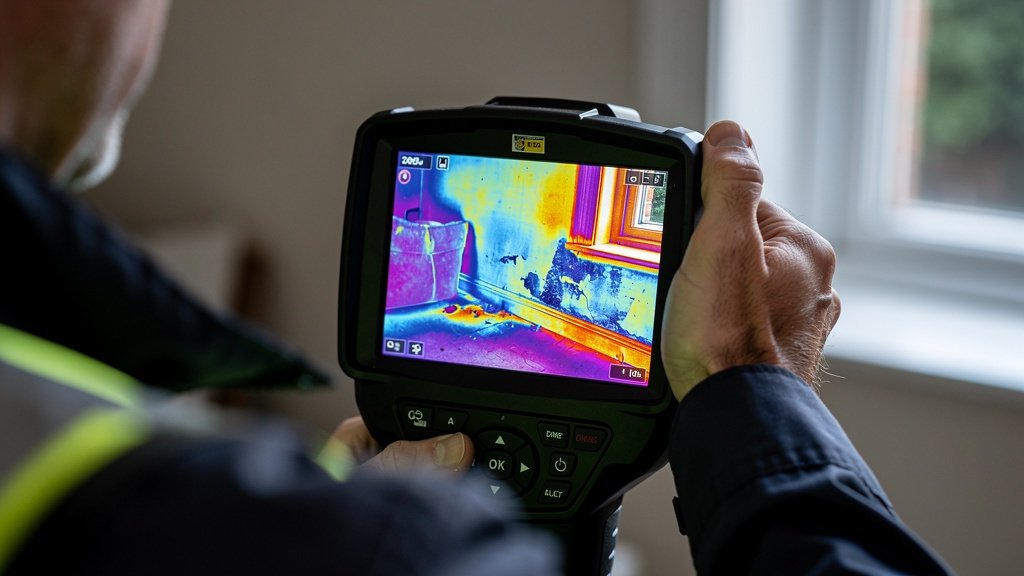
Birmingham Surveyors UK has invested in the latest thermal imaging technology to enhance our property inspection capabilities. Thermal imaging — also known as infrared thermography — is one of the most powerful tools available to modern building surveyors, enabling us to detect issues that are simply invisible to the naked eye.
What Is Thermal Imaging in Property Surveys?
Thermal imaging cameras detect differences in surface temperature and render them as colour-coded images. In a building survey context, areas of different temperature can indicate: moisture in walls or ceilings, missing or inadequate insulation, cold bridges, air leakage, electrical hotspots, and hidden pipe or service locations.
Rather than replacing traditional inspection methods, thermal imaging works alongside them — helping our surveyors identify areas that warrant closer investigation with moisture meters, endoscopes or other specialist equipment.
What Can Thermal Imaging Detect in Birmingham Properties?
Damp and Moisture Ingress
Damp areas in walls and ceilings absorb and retain heat differently from dry areas. On a thermal image, these typically appear as cooler patches — particularly visible after rainfall when the damp is being actively cooled by evaporation. This is especially valuable for detecting penetrating damp in Birmingham's Victorian properties, where moisture can travel considerable distances from its source before becoming visible.
Insulation Defects
Gaps or failures in cavity wall insulation, loft insulation or solid wall insulation show up clearly on thermal images as areas of higher heat loss. In Birmingham's post-war housing stock, many properties received cavity wall insulation during the 1980s and 1990s — and a significant proportion of this has since settled, slumped or become waterlogged. Thermal imaging can identify these failures without the need for invasive investigation.
Roof Defects and Heat Loss
Thermal imaging of roof slopes and flat roofs can identify areas of trapped moisture, missing insulation and structural heat bridges that may not be apparent during a standard inspection. For flat-roofed extensions — extremely common in Birmingham's Victorian housing stock — thermal imaging is particularly valuable.
Cold Bridges and Air Leakage
Cold bridges occur where structural elements provide an uninterrupted thermal pathway through the building envelope — junction details, window frames, balcony connections, lintel positions. These are often a significant source of heat loss and condensation risk in Birmingham properties. Thermal imaging maps them clearly.
When Should You Consider a Thermal Imaging Survey in Birmingham?
We recommend adding thermal imaging to your survey package when:
- The property has high energy bills with no obvious explanation
- There are visible signs of condensation or mould, particularly in localised areas
- The property has cavity wall insulation installed post-construction
- You are concerned about damp but standard inspection has not identified the source
- The property has a flat-roof extension or outbuilding
- You are purchasing a commercial property and want to understand energy performance
How Does Thermal Imaging Work Best?
Thermal imaging surveys are most effective when there is a significant temperature difference between inside and outside — typically at least 10°C. This means winter inspections in Birmingham are ideal. Summer surveys can still provide useful information but are often less revealing for heat-loss-related defects.
For moisture detection, surveys carried out during or shortly after rainfall tend to give the clearest results, as the differential evaporation from wet and dry surfaces creates the strongest thermal contrast.
"We added thermal imaging to a standard Level 3 survey in Edgbaston last January. It revealed a large area of failed cavity wall insulation across the entire front elevation that was invisible to every other inspection method. The buyers used it to negotiate a £4,000 insulation reinstatement contribution from the seller." — James Whitfield, Principal Surveyor
Thermal imaging is available as an add-on to any of our survey packages. We recommend it where the property or inspection conditions suggest it would add particular value. Ask us when you request your quote.
No — thermal imaging is a complementary tool that enhances a traditional survey inspection. It cannot replace the expertise of a qualified surveyor in assessing structural conditions, drainage, services and the many other elements of a comprehensive survey report.
Enquire About Thermal Imaging Surveys in Birmingham
Ask about adding thermal imaging to your next property survey. Available across Birmingham and the West Midlands.